

- Sales Hotline: 0573-84027080
- E-mail: sales@chinaoiles.com

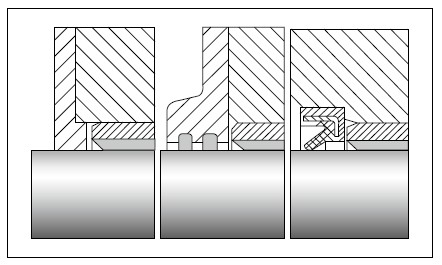
Mechanical press fit
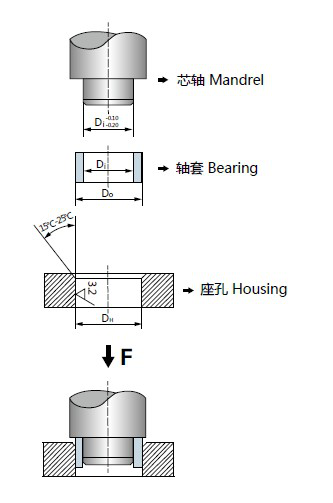
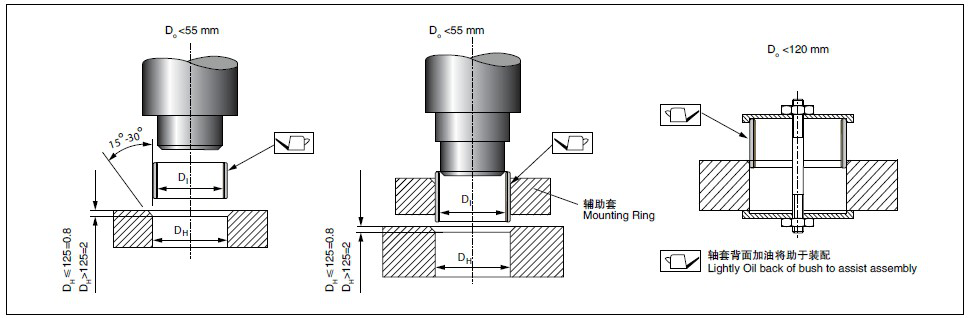
Under normal circumstances, bearings can be installed by pressure assembly. During assembly, the core shaft should be slowly pressed in, and direct hitting of the bearing is prohibited to avoid deformation. Before assembly, it should be ensured that the inner surface of the seat hole is smooth and free of foreign objects.
Frozen assembly
Cold assembly and pressing using liquid nitrogen or dry ice is more effective than mechanical pressing. At this time, the standard freezing temperature is -40 ℃~-70 ℃, and the freezing time is generally more than 1 hour, depending on the wall thickness and fit tolerance of the parts.
The shrinkage of the bearing can be calculated according to the following formula:
△ D=D×α× △ T
△ D: Outer diameter shrinkage OD
D: Bearing outer diameter OD
α: Linear expansion coefficient (1/105K)
△ T: Temperature difference
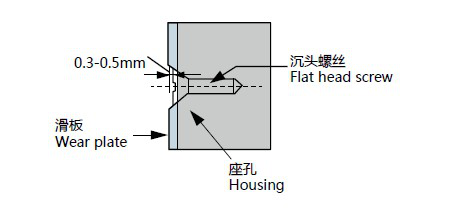
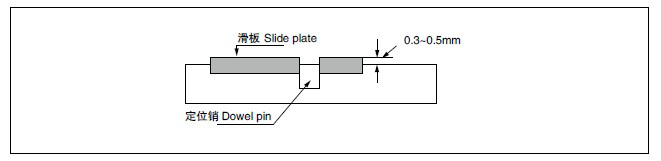
The thrust washer and sliding plate should be installed in the groove of the seat hole. To avoid the movement of the parts, it is recommended to use positioning pins or countersunk screws to fix them.
1. Installation of positioning pin
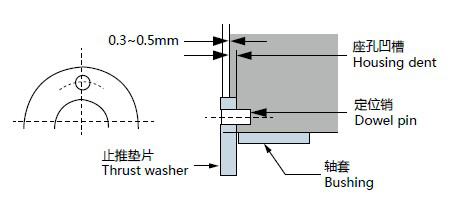
2. Inlaid installation
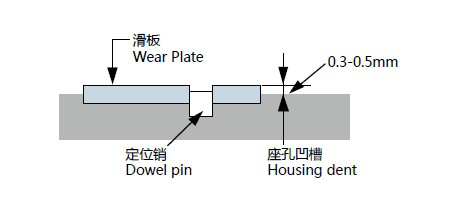
3. Installation of countersunk screws
The manufacturing process of rolled products determines the existence of open seams, which results in poor roundness of the product in a free state. At the same time, the shaft sleeve
There is an interference fit between the outer diameter and the seat hole, and the shaft sleeve needs to adapt to the shape of the seat hole to the maximum extent possible. Therefore, it is not possible to directly measure the inner and outer diameters of the product in a free state, and special measuring instruments and equipment must be used for detection; The ISO 3547 standard Part 2 specifies the tolerance inspection for rolled products, including:
Inspection method A: Haff gauge inspection of outer diameter;
Inspection method B: Check the outer diameter with a stop gauge;
Inspection method C: Check the inner diameter with a stop gauge;
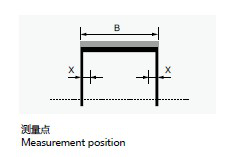
Inspection method D: Measuring ruler to inspect the outer diameter of large-sized products
And the alternative wall thickness inspection method C cannot be used simultaneously.
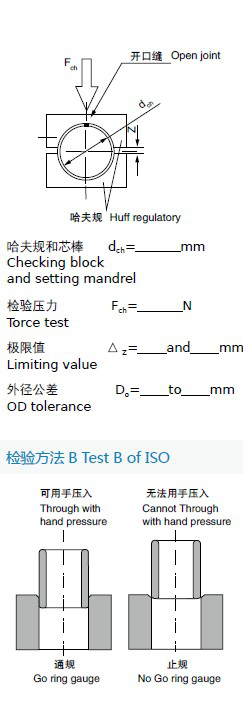
Inspection method A
Use the upper and lower Haff gauges as shown in the figure to inspect the outer diameter. During inspection, apply the inspection load Fch to the opening seam of the product facing the upper Haff gauge in the opposite direction. This load enables the rolled shaft sleeve to be located in the inspection mold in a compliant manner. During inspection, the outer diameter of the rolled shaft sleeve will decrease due to elastic deformation, but permanent deformation will not occur. The outer diameter of the product can be calculated by measuring the change △ Z in the distance Z between the inspection molds.
Inspection Method B
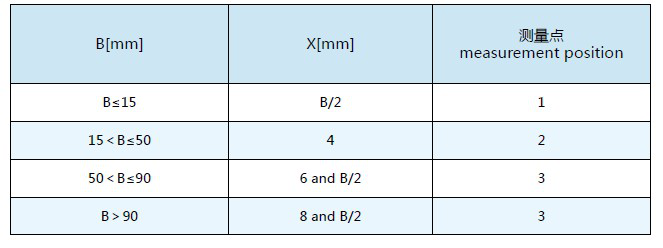
Two ring gauges, namely the through gauge and the stop gauge, are used for inspection. The shaft sleeve can be pushed in and passed through the through gauge with a maximum force of 250N by hand; Under the same circumstances, it is not possible to enter or pass through the restrictions. In some cases, the accuracy of the inspection may be affected, such as when the shaft sleeve is not round or the force of the closed opening seam itself exceeds 250N. In this case, it is recommended to use inspection method A or a combination of pressure measurement and wall thickness inspection methods.
Inspection Method C
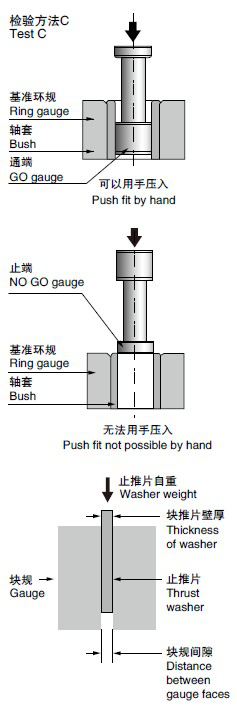
After pressing the shaft sleeve into the reference ring gauge, check the inner diameter of the shaft sleeve. The inner diameter can be measured using a three-point measuring device or a plug gauge. Considering practical use, it is generally recommended to use a plug gauge for inspection. At this time, when the maximum manual thrust does not exceed 250N, the plug gauge at the through end can pass through the inner hole of the shaft sleeve, while the plug gauge at the end should not be able to pass through the inner hole of the shaft sleeve under the same conditions. When the shaft sleeve is pressed into the reference ring gauge, the outer diameter of the shaft sleeve may cause permanent deformation and cannot be used normally.
Inspection method for thrust plate
In addition to thickness tolerance, the parallelism of gaskets is equally important for the service life of gaskets and grinding parts. We use effective inspection methods to detect the parallelism of the gasket, allowing it to pass through two parallel blocks by its own weight; Of course, the parallel block must be larger than the specifications of the gasket itself.
Wall thickness detection method
As an alternative to inspection method C, both methods cannot be used simultaneously, and the wall thickness is measured axially based on the size of the shaft sleeve.
Installation of rolled bearings
Direct installation
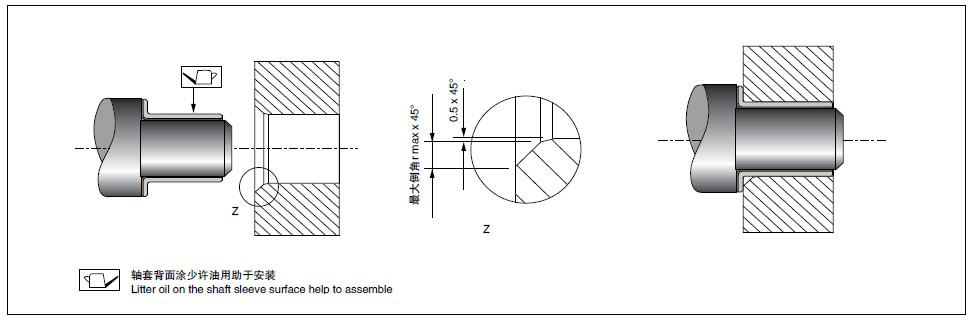
Installation of flanged sleeve
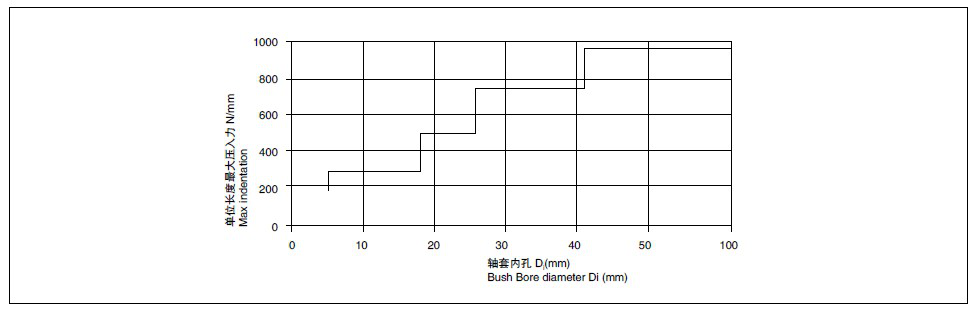
Calculation of indentation force
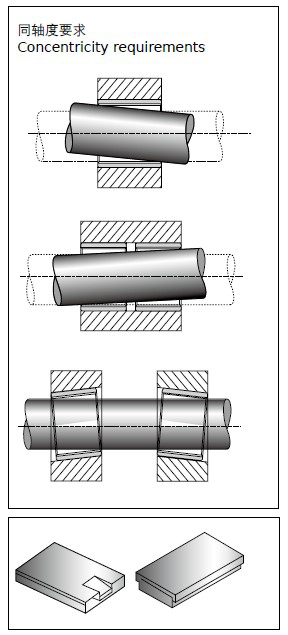
Accurate coaxiality is crucial for the normal use of bearings, and it is required that the different coaxiality of the shaft sleeve within one or two lengths, as well as the different coaxiality within the diameter of the flange or thrust plate, be controlled within 0.02mm.
Installation of gaskets and skateboards
It is recommended to install the gasket and skateboard in the recessed seat hole. To avoid movement, it is also recommended to use positioning pins for fixation.
1. Use of positioning pin on gasket
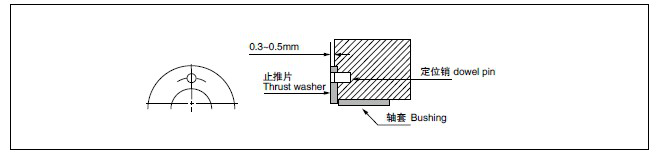
2. Use of positioning pins on skateboards
3. Use of flat head screws
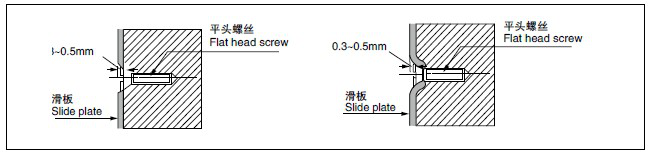
When the positioning pin cannot be used, laser welding, bonding agents, and brazing (temperature<320 ℃) can be used to fix it; At this point, it is necessary to ensure that the temperature used does not exceed the range that the bearing material itself can withstand, and to prevent the working surface of the shaft sleeve from coming into contact with adhesives, etc.
Processing and installation precautions for PTFE based bearings
PTFE based bearings are generally finished parts, and after assembly, the inner hole is no longer subjected to hinge, boring, or other processing. If the seat hole is machined according to the recommended size, the roundness of the inner diameter of the rolled bearing can fully meet the requirements for use;
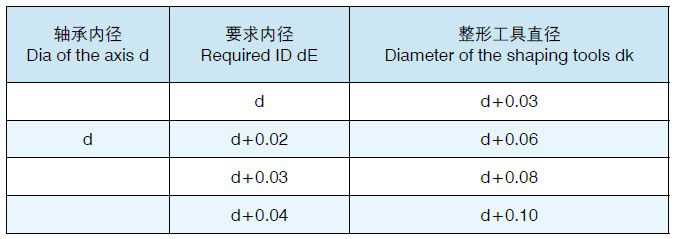
If the customer can accept a significant reduction in dry friction performance, PTFE based bearings can be subjected to inner hole extrusion after installation to achieve higher accuracy. It is strongly recommended to heat treat the surface of the extrusion core rod (depth 0.6mm, HRC>55) and polish it to Rz1;
When the specific pressure or swing of the bearing is small and stable operation is required, the working clearance can be increased. When used at high temperatures, it is recommended to reduce the shaft diameter by 0.008mm for every 100 ℃ increase;
If the material of the bearing seat is bronze, aluminum, or zinc alloy, it is recommended to reduce the bearing seat holes to increase the interference fit during bearing assembly; To ensure the rigidity of the bearing seat, the outer diameter of the bearing seat is usually 1.5 times the outer diameter of the bearing,
When using thin-walled seat holes, it is necessary to consider the deformation that may occur during pressing and use;
When PTFE bearings need to be processed, it is recommended to process or drill from the PTFE side to avoid burrs. During the drilling process, the shaft sleeve should have sufficient support to ensure that it will not deform due to drilling pressure; The processing method of strip can be achieved through methods such as shearing, water cutting, laser cutting, etc.
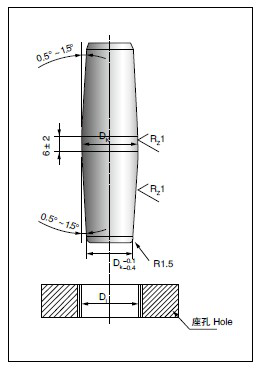
Grinding shaft
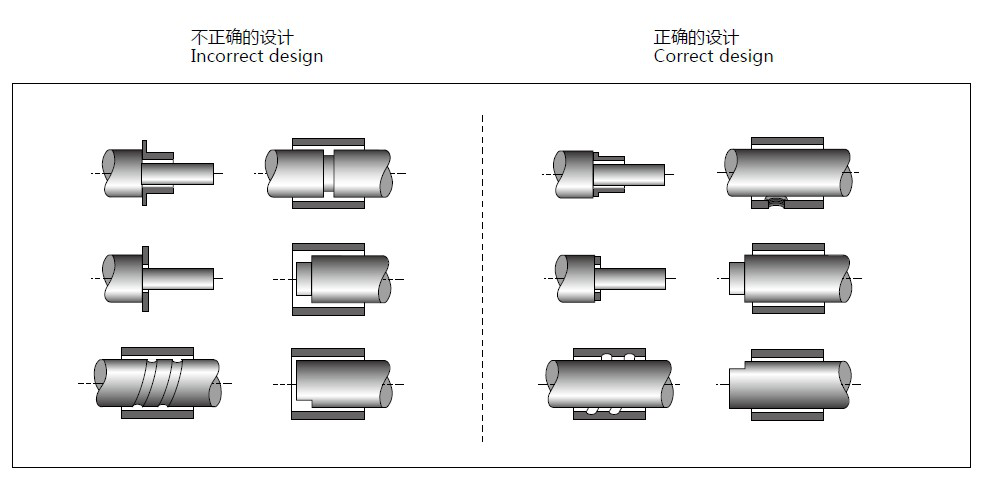
The material, surface hardness, surface roughness, and surface treatment method of the grinding parts have a significant impact on the service life of the bearings. Generally, we recommend that the hardness of the shaft be HRC>50 and the surface roughness be Ra0.4 or below; It is recommended to use stainless steel and hard chromium coating in damp or corrosive environments.
Seal
Metal plastic based self-lubricating bearings allow some foreign objects that will not damage the surface material of the bearing to enter, but when the intrusion of foreign objects increases or high abrasive substances enter, verified sealing rings should be installed to improve the service life of the bearing.